![People with Inconvenient Truths about Transphobes [PITT]](https://substackcdn.com/image/fetch/$s_!YttD!,w_80,h_80,c_fill,f_webp,q_auto:good,fl_progressive:steep,g_auto/https%3A%2F%2Fsubstack-post-media.s3.amazonaws.com%2Fpublic%2Fimages%2F704ba0db-3e10-4112-9364-c2f224d0cfae_500x500.png)
Part 4: Incomplete Is Their Middle Name
How Ayad Misrepresents Affirming Care

⚠️ CONTENT WARNING: This article analyzes anti-trans propaganda that attacks gender-affirming healthcare through lies, conversion therapy rhetoric, and psychological manipulation tactics. We thoroughly debunk these harmful narratives with evidence and necessary snark, but the source material contains deeply harmful ideologies about trans people and their medical care. Please prioritize your mental health.

There’s a special kind of audacity required to attack evidence-based healthcare while selling your own discredited alternative for $285 an hour. It’s the same energy as someone setting fire to a hospital while advertising their healing crystals. But that’s exactly what we witness in this video of Sasha Ayad’s “Metaphor of Gender” series called “Gender Affirming Therapy is Incomplete”, where she graduates from philosophical manipulation to full-throated assault on gender-affirming care.
“Gender Affirming Therapy is Incomplete,” the title declares, with all the subtlety of a conversion therapist at Pride. But here’s the thing about projection. It always tells on itself. The “incomplete” therapy Ayad decries? That would be her own approach, which somehow manages to ignore decades of research, medical consensus, and basic therapeutic ethics while claiming to offer “real” psychological care.
We’ve watched this pipeline develop across three videos. First came the philosophical seduction (“gender is just a metaphor”), then the audience filtering (“are you curious enough?”), followed by the framework installation (“seven principles of gender metaphor”). Now, with her viewers properly primed, Ayad launches her attack on the very foundations of evidence-based trans healthcare.
But this video isn’t just another manipulation in the series. It’s a meta-deception, a house of cards where every lie depends on every other lie to remain standing. Pull one thread, and watch the entire elaborate structure collapse into the pile of debunked conversion therapy tactics it always was.
Welcome to the attack phase of Ayad’s manipulation pipeline, where “keeping one foot in reality” means standing knee-deep in fabrication.
The Meta-Deception Framework
Before we dissect the individual components of Ayad’s assault, we need to understand what makes this video unique in her manipulation pipeline. This isn’t a collection of separate deceptive tactics that happen to appear together. It’s a meta-deception, a sustained, interconnected lie where each false claim requires and reinforces all the others.
Think of it as a house of cards in a hurricane of facts. Each card must lean on its neighbors to remain upright. “Therapy is broken” justifies her alternative approach. “One session surgery letters” creates the necessary panic. “Real therapy means change” disguises conversion therapy as depth. “Sexual orientation is different” borrows gay acceptance to attack trans people. “I understand complexity” manufactures false authority. “Activists attack me” invalidates all criticism.
Remove any single card, and the entire structure topples. This is by design. It makes the deception harder to address because responding to one false claim feels incomplete without addressing them all. It’s meant to exhaust fact-checkers and overwhelm critical analysis.
But once you recognize the pattern, you can appreciate the elegant simplicity of demolishing it. We’re not dealing with six separate problems. We’re dealing with one big lie wearing six different masks.
Let’s pull some threads.
The Strawman That Ate Manhattan
At the 8-minute mark, Ayad delivers a most brazen fabrication:
“This counseling center meets with patients one time to determine if they can provide a letter for surgery. One meeting is all it takes to discuss one of the most important decisions you’ll ever make in your life.”
This isn’t just wrong. It’s impossible. It’s like claiming hospitals perform heart surgery in the waiting room or that you can get a PhD from a vending machine. The strawman she’s constructing here isn’t just misleading. It’s so massive it needs its own zip code.
🚩 Red Flag #1: Manufacturing Medical Panic Through Pure Fiction
Let’s be crystal clear. No legitimate healthcare provider issues surgery letters after one session. The actual requirements, according to WPATH Standards of Care Version 8[1], include persistent, well-documented gender dysphoria, capacity for fully informed consent, age of majority (with rare, carefully evaluated exceptions), treatment of any co-occurring mental health concerns, living in congruent gender role (duration varies by procedure), and letters from TWO qualified mental health professionals for genital surgeries.
But wait, there’s more! Ayad immediately compounds this lie:
“I’ve worked with hundreds and hundreds of families whose children were seen just one time and recommended to medically transition and those were minors.”
“Hundreds and hundreds”? Really? If this were true, it would be the medical scandal of the century. Where are the malpractice suits? The medical board investigations? The insurance fraud charges? The documentation of any kind?
Even if we took this dubious claim at face value, what does she mean precisely with this phrasing? Consider if it would be reasonable for an experienced psychologist to meet with a patient one time and listen for an hour about how the patient has wanted to medically transition for years. How, when pressed and discussed, all the risks, dangers, unknowns are all well understood, rationalized, and accepted by the patient. Would it then be unprofessional to give an opinion that “this person would likely benefit from starting to transition”? That’s called informed consent, and it’s how adult medical decisions work.
They don’t exist because this didn’t happen. It’s fan fiction for transphobes, a bedtime story for parents who want to believe their trans kids are victims of medical conspiracy rather than, you know, trans.
What Gender-Affirming Care Actually Looks Like
Since Ayad won’t tell you what really happens in gender-affirming care, let’s fill that massive gap with actual facts.
Evidence Box: The Reality Ayad Won’t Show You
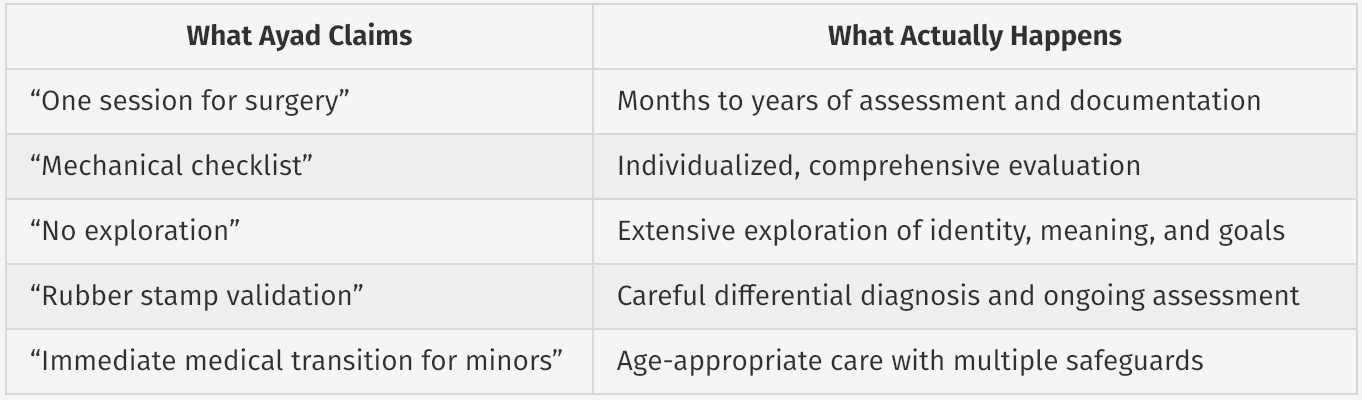
The truth? Gender-affirming care is a comprehensive, evidence-based approach developed through decades of clinical experience. The American Psychological Association Guidelines[2] describe what the process actually involves.
Initial assessment takes multiple sessions over weeks or months. It includes comprehensive psychosocial history, gender identity development exploration, assessment of dysphoria and its impact, evaluation of co-occurring conditions, family and support system assessment, and discussion of all options, not just medical ones.
Ongoing therapeutic support continues throughout the process. This involves processing experiences of gender and identity, developing coping strategies for minority stress, addressing internalized transphobia, supporting decision-making about any transitions, family therapy when appropriate, and crisis support as needed.
If medical interventions are considered, which takes additional months or years, the process includes extensive informed consent per UCSF Guidelines[3], medical evaluation and baseline testing, coordination between multiple providers, regular monitoring and adjustment per Endocrine Society Clinical Practice Guidelines[4], continued therapeutic support, and documentation at every step.
For surgical interventions specifically, since Ayad seems obsessed with her “one session” fantasy, the actual requirements according to Coleman et al.[5] typically include 12+ months of hormone therapy for most procedures, 12+ months living in congruent gender role, two letters from qualified mental health professionals, medical clearance from primary care provider, surgical consultation and planning, and insurance authorization often requiring additional documentation.
This isn’t a drive-through service. It’s a careful, collaborative process that respects both the significance of these decisions and the autonomy of the people making them.
The “Real Therapy” Con Game
Here’s where Ayad reveals what she’s really selling. At 3:45, she declares:
“Real therapy is about change. It’s not just about feeling validated, but it’s about seeing yourself more clearly, challenging your unhelpful patterns, and then building a life that actually works for you.”
Sounds reasonable until you decode what she means in the context of trans identity. “Change” means stop being trans. “Seeing yourself clearly” means accept your assigned gender. “Challenging unhelpful patterns” means reject gender nonconformity. “Life that works” means conform to cisgender expectations.
🚩 Red Flag #2: Conversion Therapy in a Psychological Suit
The tell is her obsession with “wholeness.” Throughout the video, she frames trans identity as fragmentation, “disparate parts” that need integration into a “whole” that is, coincidentally, always cisgender. This is textbook conversion therapy language, the same framework used against gay people for decades as documented by SAMHSA[6].
But here’s the thing about wholeness. Forcing someone to deny a fundamental aspect of their identity doesn’t create integration. It creates dissociation. Real wholeness includes all aspects of self, including gender identity. The fragmentation Ayad claims to heal? She’s actually causing it.
What’s particularly galling is her claim that affirming therapy is “superficial.” Let’s think about this. What’s more superficial than refusing to engage with someone’s stated identity? What’s more avoidant than dismissing dysphoria as an “unhelpful pattern”? What’s shallower than insisting everyone must fit into the gender box checked at birth?
Her “deep” therapy amounts to “You’re not really trans, you’re just confused.” That’s not depth. That’s denial dressed up in psychological jargon.
The Gay Card: A Weapon of Mass Distraction
At 9:41, Ayad plays what she clearly thinks is her trump card:
“Being attracted to someone doesn’t require any medical interventions. But people who are exploring a cross-sex identity or non-binary gender might end up seeking to change their bodies.”
This comparison serves a specific function. It lets her borrow the moral authority of gay acceptance while undermining trans acceptance. It’s like using Rosa Parks to argue against disability rights. A complete non sequitur wrapped in false equivalence.
🚩 Red Flag #3: Weaponizing LGB to Attack the T
The problems with this comparison are numerous and fatal to her argument.
First, plenty of gay people have needed medical interventions, from HIV treatment that kept them alive to hormone therapy for those escaping conversion torture. The idea that being gay involves no medical considerations erases huge swaths of queer history as documented by Drescher[7].
Second, many trans people never pursue medical transition at all. Social transition requires zero medical intervention. By equating trans identity with surgery, Ayad erases, or for the sake of her argument, conveniently avoids a large cross-section of trans experiences.
Third, and this is crucial, every argument she makes against trans identity was made against gay identity. “It’s confusion, not reality.” “It’s social contagion.” “It needs therapy to address underlying issues.” “Affirmation is harmful enabling.”
The recycling is so obvious it’s almost as boring as it is embarrassing. She’s literally reading from the 1970s conversion therapy playbook, just with find-and-replace on the terminology, as Bryant documented regarding the pathologization of gender nonconformity in children[8].
The Authority Masquerade
Ayad spends significant time establishing her multicultural background and diverse interests, presenting herself as someone who understands complexity and therefore can diagnose when others are “confused” about their gender.
“I grew up in an Egyptian-American family, moving across multiple cities, states, and even countries.”
🚩 Red Flag #4: Identity Tourism as Expertise
Being Egyptian-American doesn’t make you a gender expert. Having diverse hobbies doesn’t qualify you to deny others’ identities. This is like claiming you understand diabetes because you’ve eaten at different restaurants.
The “chameleon” metaphor she uses is particularly telling. She frames changing presentation while maintaining a fixed core as healthy, but for trans people, that “core” might be precisely what needs expression. Her model assumes the surface is performance while the “truth” stays hidden. But what if the truth needs to be visible? What if authenticity requires external congruence with internal reality?
Notice how she claims to be “drawn to outsiders” while her entire practice is about forcing insiders back into the mainstream box of cisgender conformity. This contradiction speaks volumes.
Playing the Victim While Dealing Damage
At 10:59, Ayad deploys the classic DARVO (Deny, Attack, Reverse Victim and Offender):
“Because I’ve stood up for what I believe to be real therapy, activists have tried to destroy my career.”
🚩 Red Flag #5: DARVO Tactics to Deflect Criticism
Let’s be clear. When the American Psychological Association[9], American Medical Association, American Academy of Pediatrics, Endocrine Society[10], and WPATH[11] all oppose your approach, that’s not “activist persecution.” That’s professional consensus that you’re wrong.
The UN Independent Expert on protection against violence and discrimination based on sexual orientation and gender identity has specifically identified these practices as conversion therapy that causes documented harm[12].
When former clients share negative experiences, that’s not harassment. That’s accountability. When colleagues distance themselves, that’s not cancellation. That’s recognition that your methods harm people.
But the victim narrative is essential to her meta-deception. It preemptively frames all criticism as persecution, making her followers feel like they’re part of a besieged truth-telling movement rather than consumers of repackaged conversion therapy.
She even adds this gem: “Some people who also share my concerns about gender affirming therapy think I am too nuanced and too compassionate.”
See? She’s attacked from both sides! She must be perfectly balanced! This “radical moderate” positioning is designed to make extremism look reasonable.
Remember, history teaches us this pattern:
60s: “They call everything racist now!”
80s-90s: “Political correctness gone mad!”
00s: “Everything is homophobic”
Now: “Everything is transphobic”
When marginalized groups name discrimination, those defending the status quo dismiss it as oversensitivity or meaningless buzzwords.
The Numbers Game Nobody Wins
Though we covered the “hundreds and hundreds” claim in our first red flag, I want to highlight how this fabrication does double duty in Ayad’s meta-deception. It’s not just about manufacturing medical panic. It’s also about creating an entire evidence base out of thin air.
Throughout the video, Ayad makes sweeping claims about “hundreds and hundreds of families” without a shred of evidence, documentation, or even specific examples.
🚩 Red Flag #6: Anecdotes Cosplaying as Data
If hundreds of children were receiving transition recommendations after single sessions, this would be documented everywhere. Medical boards would investigate. Insurance companies would refuse coverage. Malpractice suits would proliferate. Professional licenses would be revoked.
None of this has happened because none of this is happening.
Meanwhile, actual data shows regret rates for gender-affirming care are below 1%. Mental health improves with appropriate support according to Tordoff et al.[13]. Suicide risk decreases with affirmation according to Turban et al.[14]. Family acceptance dramatically improves outcomes per the Trevor Project National Survey[15]. And conversion therapy attempts increase suicide risk according to Turban et al.[16].
But real data would demolish her house of cards, so instead she offers ghost stories. Invisible hundreds who conveniently support her narrative while remaining completely unverifiable.
The House of Cards in the Hurricane
Now let’s watch the whole elaborate structure collapse.
Pull the “therapy is broken” card: If gender-affirming care actually follows rigorous standards and has positive outcomes, there’s no need for her alternative.
Remove the “one session” lie: Without manufactured panic about reckless affirmation, her approach is a solution in search of a problem.
Challenge “real therapy equals change”: If therapy can involve accepting trans identity, her framework is revealed as conversion therapy.
Examine the false equivalence: The comparison to sexual orientation actually supports affirmation, making her argument self-defeating.
Question her authority: Being multicultural doesn’t make you a gender expert; her claimed expertise evaporates.
Address the victim narrative: Professional criticism based on evidence isn’t persecution; it’s quality control.
Verify the numbers: Without the phantom hundreds, her evidence base disappears entirely.
Each lie requires the others. Remove any one and the entire argument fails. The incomplete therapy? It’s hers.
The Incomplete Therapist
After nearly 13 minutes of projection so intense it deserves its own DSM/ICD diagnostic code, Ayad signs off with “keeping one foot in reality and one in possibility.” The irony is very real. Her “reality” foot stands firmly in debunked conversion therapy, while her “possibility” foot kicks away the possibility that trans people know who they are.
The true incompleteness here reveals itself in her incomplete engagement with evidence, her incomplete respect for client autonomy, her incomplete understanding of gender diversity, her incomplete adherence to professional ethics, and her incomplete honesty about her own agenda.
What we’re witnessing in this video is the critical escalation point of Ayad’s “Metaphor of Gender” pipeline. The philosophical groundwork laid, the audience filtered and primed, the framework installed, now comes the direct attack on evidence-based care. She’s created a crisis narrative that positions affirming care as dangerous, which then justifies her conversion therapy approach and that of her ideological allies in organizations like SEGM and Genspect as necessary alternatives.
But here’s what I suspect Ayad will not admit, if not to herself, certainly not to you or me. The incomplete therapy isn’t gender-affirming care that follows rigorous protocols, involves comprehensive assessment, and demonstrates positive outcomes. The incomplete therapy is her approach that ignores evidence, dismisses identity, and recycles conversion tactics that professional organizations have condemned for decades.
Wholeness through denial isn’t wholeness.
It’s a hole where authentic self should be.
🚩 Red Flag Summary: The Meta-Deception Exposed
The Six Cards in the House:
Blatant lies about standard care (“one session surgery”)
Conversion therapy language disguised as depth (“wholeness”)
Weaponizing gay acceptance against trans people (false equivalence)
Fake expertise from personal complexity (identity ≠ authority)
DARVO tactics to deflect criticism (“activists destroying me”)
Ghost statistics with zero evidence (“hundreds of families”)
The Meta-Truth: This entire video is one sustained deception where each lie requires the others. Pull any thread, watch it all unravel.
Coming in Part 5: Having attacked affirming care, Ayad will pathologize trans identity itself. The pipeline deepens, the rhetoric darkens, and the conversion agenda becomes impossible to hide.
Continue to Part 5: “The Pathologization Play: How Ayad’s Pipeline Makes Identity a Disease”
About This Series: People With Inconvenient Truths about Transphobes (PITT) is exposing the sophisticated conversion therapy pipeline hidden in Sasha Ayad’s “Metaphor of Gender” series. Each article analyzes one video, revealing the manipulation tactics and countering with evidence-based reality. For $285 per session, Ayad sells repackaged conversion therapy. For free, we’re showing you exactly how the scam works.
Citations
[1] WPATH Standards of Care for the Health of Transgender and Gender Diverse People, Version 8. (2022). World Professional Association for Transgender Health. International Journal of Transgender Health, 23(S1), S1-S259.
[2] American Psychological Association. (2021). Guidelines for Psychological Practice with Transgender and Gender Nonconforming People. American Psychologist, 70(9), 832-864.
[3] University of California San Francisco. (2016). Guidelines for the Primary and Gender-Affirming Care of Transgender and Gender Nonbinary People. UCSF Transgender Care.
[4] Hembree, W. C., et al. (2017). Endocrine Treatment of Gender-Dysphoric/Gender-Incongruent Persons: An Endocrine Society Clinical Practice Guideline. Journal of Clinical Endocrinology & Metabolism, 102(11), 3869-3903.
[5] Coleman, E., et al. (2022). Standards of Care for the Health of Transgender and Gender Diverse People, Version 8. International Journal of Transgender Health, 23(S1), S1-S259.
[6] Substance Abuse and Mental Health Services Administration. (2015). Ending Conversion Therapy: Supporting and Affirming LGBTQ Youth. HHS Publication No. (SMA) 15-4928. Rockville, MD: SAMHSA.
[7] Drescher, J. (2015). Out of DSM: Depathologizing Homosexuality. Behavioral Sciences, 5(4), 565-575.
[8] Bryant, K. (2006). Making gender identity disorder of childhood: Historical lessons for contemporary debates. Sexuality Research & Social Policy, 3(3), 23-39.
[9] See [2] above.
[10] See [4] above.
[11] See [1] above.
[12] United Nations Independent Expert on protection against violence and discrimination based on sexual orientation and gender identity. (2020). Report on Conversion Therapy Practices. A/HRC/44/53.
[13] Tordoff, D. M., et al. (2022). Mental Health Outcomes in Transgender and Nonbinary Youths Receiving Gender-Affirming Care. JAMA Network Open, 5(2), e220978.
[14] Turban, J. L., et al. (2021). Access to gender-affirming hormones during adolescence and mental health outcomes among transgender adults. PLOS ONE, 17(1), e0261039.
[15] The Trevor Project. (2022). 2022 National Survey on LGBTQ Youth Mental Health. New York: The Trevor Project.
[16] Turban, J. L., et al. (2020). Association Between Recalled Exposure to Gender Identity Conversion Efforts and Psychological Distress and Suicide Attempts Among Transgender Adults. JAMA Psychiatry, 77(1), 68-76.